

How Trade Promotion Agencies Organise National Stands in East Africa
Updated: May 8
Trade promotion agencies and government bodies are sending more national delegations to trade shows in East Africa than ever before. Kenya, Ethiopia, Tanzania, and Rwanda host hundreds of international exhibitions annually, and country pavilions have become a critical tool for governments looking to open markets, support exporters, and strengthen bilateral trade relationships in the region. Getting the planning right is what separates a pavilion that generates real commercial outcomes from one that simply fills space.

What a Country Pavilion at an East African Trade Show Actually Involves
A country pavilion is a unified exhibition space where multiple companies from the same country exhibit under a shared national brand. Unlike individual exhibition stands, a pavilion presents a cohesive visual identity that represents the nation's industries, products, and economic strengths as a collective.
In East Africa, country pavilions are a regular feature at major trade shows. Events like Buildexpo Kenya, Big 5 Construct Kenya, WHX Nairobi, Medexpo, and GITEX Kenya consistently feature dedicated pavilions from countries including Egypt, Germany, China, India, Italy, and Turkey. The Egypt Pavilion at Big 5 Construct Kenya 2025, for example, facilitated direct partnership meetings between Egyptian companies and Kenyan developers, with bilateral trade reaching over $333 million that year.
For trade promotion agencies, these pavilions serve a dual purpose. They provide a professional platform for national exporters to access East African buyers, and they signal government-level commitment to the market, which builds credibility and trust with local partners.

How Trade Promotion Agencies Select the Right Exhibition for a National Pavilion
Choosing the right event is the first strategic decision. East Africa's exhibition calendar is dense, and not every trade show suits every national delegation. The selection should align with the country's priority export sectors, the quality and profile of expected visitors, and the strategic importance of the host country market.
A trade promotion agency representing manufacturing companies would prioritise events like Buildexpo or INDUSMACH. An agency supporting health technology exports would look at WHX Nairobi or Medexpo. For technology and digital innovation, GITEX Kenya is the natural fit.
The selection process should also consider timing and geography. Kenya's exhibition calendar runs year-round, but Ethiopia and Tanzania have their own parallel events. Agencies with ambitions across the entire East African region can plan multi-country participation within a single quarter by combining events in Nairobi, Addis Ababa, and Dar es Salaam.

Budgeting and Funding for Government Exhibition Pavilions in East Africa
Country pavilion budgets are typically funded by government trade promotion programmes, sometimes with co-funding from participating exhibitors or industry associations. The budget needs to cover several categories that are often underestimated by agencies new to the East African market.
The core costs include exhibition space booking, pavilion design and fabrication, graphic production, furniture and AV equipment, electrical and rigging services, and on-site management. Beyond the build, agencies should budget for exhibitor coordination, promotional activities, printed materials, hospitality provisions, and post-event reporting.
In East Africa, local fabrication is almost always more cost-effective than shipping pavilion structures from overseas. Customs clearance for temporary imports can be complex and time-consuming, and delays at port or during documentation can put the entire pavilion timeline at risk. Agencies that work with a local exhibition stand builder for design and fabrication avoid these risks entirely while also benefiting from the builder's direct relationships with venues and event organisers.
Designing a Country Pavilion That Works for Multiple Exhibitors in East Africa
Pavilion design for trade shows in East Africa requires a balance between national branding and individual exhibitor visibility. The overall structure needs to project a unified national identity, with consistent colours, materials, and messaging that reflect the country brand. At the same time, each participating company needs enough space and visual distinction to present their own products and have meaningful conversations with visitors.
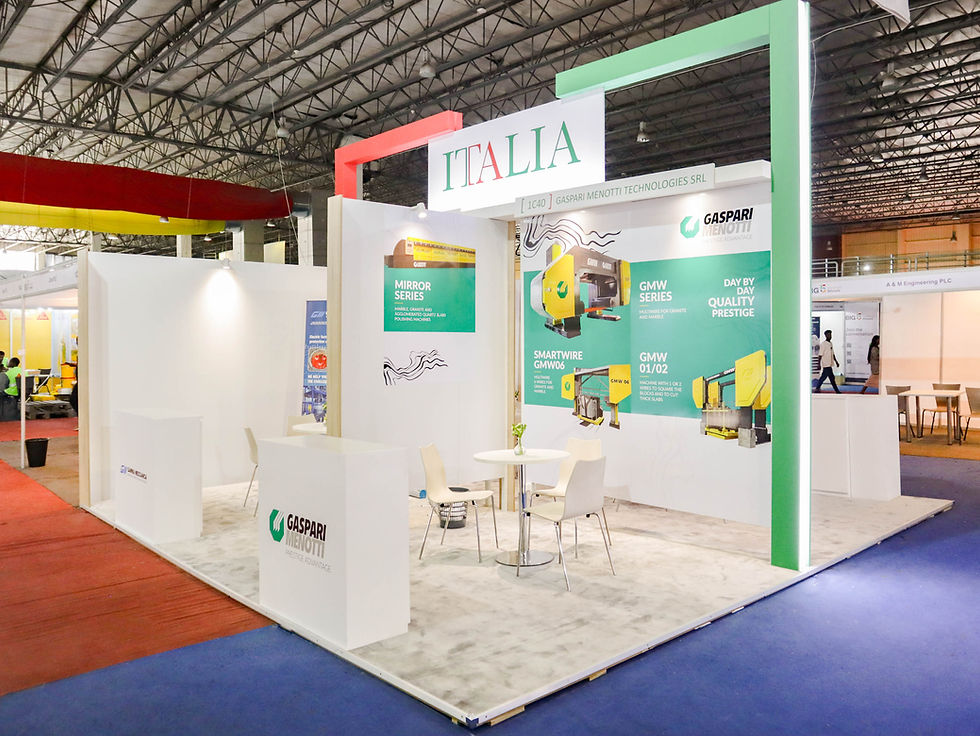
Successful pavilion layouts typically include a prominent entrance arch or header displaying the national brand, individual booths or stations for each exhibitor arranged within the shared space, a central meeting or hospitality area for hosted conversations, and clear signage and wayfinding that helps visitors navigate the pavilion efficiently.
The design should also account for the specific conditions of East African exhibition venues. KICC Nairobi and the Sarit Expo Centre have different ceiling heights, floor load capacities, and access routes. A pavilion concept designed without knowledge of the actual venue often requires costly last-minute modifications. Working with a stand builder who has built at the specific venue eliminates this risk.

Coordinating Multiple Exhibitors Within a National Pavilion
Managing multiple exhibitors under one pavilion roof is one of the most complex aspects of country pavilion planning. Each participating company has its own products, priorities, and expectations, and the agency needs to align all of them within a coherent framework.
Start early. Agencies should confirm participating exhibitors at least three to four months before the event. This allows time to collect branding materials, understand product display requirements, allocate booth sizes appropriately, and produce individual graphics within the shared design language.
Clear exhibitor guidelines help enormously. These should cover booth dimensions, what is included in each exhibitor package (furniture, lighting, power, signage), any restrictions on standalone branding, and the schedule for setup and dismantling. The more clarity agencies provide upfront, the fewer issues arise on site.
A dedicated project manager on the ground in East Africa, whether from the agency or from the local stand builder, is essential. Someone who can handle last-minute changes, liaise with the venue and event organisers, and troubleshoot problems during the event protects the agency from the kinds of logistical surprises that can undermine an otherwise well-planned pavilion.

Managing Exhibition Logistics for National Pavilions in East Africa
Logistics planning for country pavilions in East Africa is where many agencies encounter unexpected challenges. Venue access windows can be tight, sometimes limited to just one or two days before the exhibition opens. Electrical connections, rigging, and internet services need to be ordered through the event organiser well in advance. Graphic production and furniture rental operate on local timelines that differ from what European or Asian agencies are accustomed to.
The most reliable approach is to centralise logistics management with a single local partner. A local exhibition stand builder who handles design, fabrication, venue coordination, organiser liaison, and on-site setup and dismantling removes the need for the agency to manage multiple suppliers across different time zones. This is especially important for agencies coordinating their first pavilion in the region, where unfamiliarity with local processes can lead to costly delays.
Agencies should also plan for the post-event phase. Dismantling timelines are strict at most East African venues, and materials need to be removed promptly. If the pavilion structure will be reused at a subsequent event in the region, storage arrangements should be confirmed before the first event begins.
Promotional Activities That Drive Visitor Traffic to Country Pavilions
A well-designed pavilion that sits quietly on the show floor will underperform. Trade promotion agencies need to plan promotional activities that actively draw visitors into the pavilion and create reasons for attendees to stay and engage.
Effective tactics include hosting a formal opening ceremony or ribbon-cutting with a senior diplomatic or trade representative, scheduling B2B matchmaking sessions within the pavilion during the event, offering product demonstrations or live presentations at set times throughout the day, distributing a pavilion guide or brochure that profiles each exhibitor, and coordinating media coverage through local press and industry publications.
In East African trade shows, personal engagement is particularly effective. Having a pavilion host who greets visitors, introduces them to relevant exhibitors, and facilitates introductions adds a human layer that generic signage cannot replicate. This role is especially important when exhibitors are new to the market and may not yet have established local relationships.
Measuring Country Pavilion Success and Reporting Outcomes
Trade promotion agencies are accountable to their funding bodies, and demonstrating return on investment is essential for securing future budgets. Building a measurement framework before the event ensures that meaningful data is captured during and after the exhibition.
Track the number of qualified leads generated by each exhibitor, the number of scheduled meetings held within the pavilion, any contracts or memoranda of understanding signed during or immediately after the event, media coverage and social media engagement, and visitor feedback collected through short surveys or digital forms.
Post-event reporting should synthesise these metrics into a clear narrative that connects pavilion participation to commercial outcomes. Include exhibitor testimonials, photographs of the pavilion and key interactions, and recommendations for future participation. This reporting loop is what turns a one-off pavilion into a recurring strategic programme.

Build Your Country Pavilion in East Africa with Exhibit Africa
Planning a national pavilion for a trade show in East Africa demands local expertise, reliable execution, and a partner who understands the specific requirements of government and institutional exhibitors.
Exhibit Africa specialises in designing, building, and managing country pavilions for trade promotion agencies, government ministries, and industry associations across Kenya, Ethiopia, and Rwanda. From initial concept and exhibitor coordination to local fabrication, venue logistics, and full on-site management, we deliver end-to-end pavilion solutions that represent nations at the highest standard.
Planning a country pavilion for an upcoming trade show in East Africa? Contact Exhibit Africa and let us handle every detail.
Comments