

How Modular Exhibition Stand Systems Reduce Costs and Carbon Footprints in Africa
If you exhibit at trade shows in Africa more than once a year, building a new custom stand from scratch each time is the most expensive and most wasteful way to do it.
Modular exhibition stand systems offer a fundamentally different approach. They are designed to be reconfigured, reused, and refreshed across multiple events, delivering lower costs over time and a significantly smaller environmental footprint.

The Problem With Single-Use Exhibition Stands at African Trade Shows
The traditional approach to exhibition stand construction is what the industry calls "build and burn." A custom timber stand is designed, fabricated, installed, used for three days, dismantled, and sent to landfill. The cycle repeats at the next event. Every component, from the structural framework and graphic panels to furniture fittings and flooring, is treated as disposable.
This model is expensive. You pay full design, fabrication, material, transport, installation, and disposal costs for every single event. There is no carry-over value from one exhibition to the next. If you exhibit at three events per year across Kenya, Ethiopia, and Egypt, you are effectively paying for three complete stand builds annually.
It is also wasteful. The exhibition industry globally produces enormous volumes of construction waste, much of it timber, MDF, vinyl, and mixed materials that go straight to landfill after a single use. For companies that have corporate sustainability commitments or ESG reporting requirements, this model creates a direct conflict between marketing activity and environmental targets.
What Modular Exhibition Stand Systems Actually Are
A modular exhibition stand is built from a system of standardised, reusable structural components that can be assembled, reconfigured, and reused across multiple events. The core framework, typically lightweight aluminium profiles with precision connectors, remains the same from event to event. What changes between shows is the configuration, the graphic panels, and the layout.
Think of it as the difference between building a new house every time you move versus owning furniture that fits different rooms. The aluminium framework, connectors, shelving systems, and lighting hardware are your permanent assets. The tension fabric graphics, printed panels, and branded elements are refreshed as needed, at a fraction of the cost of rebuilding the entire structure.
Modern modular systems are not the generic, corporate-looking shell scheme upgrades of ten years ago. Today's systems produce stands that are visually indistinguishable from high-end custom builds. Clean lines, seamless graphic integration, integrated lighting, and flexible configurations mean that a well-designed modular stand looks every bit as premium as a traditional custom build, without the waste or the recurring cost.

How Modular Systems Cut Exhibition Stand Costs Over Multiple Events
The cost advantage of modular exhibition stands becomes dramatic when you exhibit at more than one event per year. Industry data shows that companies using reusable modular systems report 30 to 50% lower long-term exhibition costs compared to traditional single-use construction.
The savings come from multiple sources. The structural framework is a one-time investment that is reused indefinitely. Only the graphic elements are refreshed between events, which typically costs a fraction of a full stand build. Assembly and dismantling are faster because modular systems use tool-free or minimal-tool connections, reducing labour costs. And because the components are lighter than traditional timber and MDF construction, transport and handling costs are lower.
For a company exhibiting at three Big 5 Construct events across Africa in a single year, the maths is straightforward. Three custom builds means three full design and fabrication budgets. One modular system with three graphic refreshes and three installation fees means the structural investment is made once and the ongoing costs cover only what changes. Over a three-year programme of three shows per year, the cumulative savings are substantial.
This is particularly relevant for exhibitors in Africa, where building locally is already the most cost-effective approach. A local stand builder who stores your modular components between events and reconfigures them for each new venue eliminates both international shipping costs and the waste of single-use builds.
How Modular Exhibition Stands Reduce Environmental Impact and Carbon Footprints
The environmental case for modular systems is equally compelling. Reusable exhibition stands can reduce event-related waste by up to 80% compared to single-use builds. They produce approximately 70% less material waste than custom timber construction and reduce transport emissions by up to 60% through lighter weight and flat-pack logistics.
These reductions come from eliminating the cycle of raw material consumption, fabrication waste, and post-event disposal that defines traditional stand construction. When a modular framework is reused across nine events over three years instead of being built and discarded nine times, the cumulative material saving is enormous.
The aluminium profiles used in most modular systems are 100% recyclable at end of life. Unlike MDF, plywood, and vinyl, which typically go to landfill, aluminium retains its value and can be recycled indefinitely without loss of quality. Even the graphic panels, which are the primary consumable in a modular system, can be produced using sustainable materials including recycled fabrics and water-based inks.
For companies with ESG reporting requirements, modular exhibition stands provide measurable data. You can quantify the reduction in material consumption, waste volume, and transport emissions compared to traditional builds, giving your sustainability team concrete numbers to include in corporate reporting.
Modular Exhibition Stands for Multi-Event Strategies Across Africa
The real power of modular systems emerges when you are exhibiting at multiple events across different countries and venues within the same year. A company that attends Intersolar Africa in Nairobi, Big 5 Construct Ethiopia in Addis Ababa, and Gulfood360 in Dubai needs a stand system that adapts to three different venues, three different stand sizes, and three different audience profiles.
A modular system handles this naturally. The same structural components can be configured as a 12 square metre inline stand at one event and expanded to a 24 square metre corner stand at another. Graphic panels are swapped to emphasise different products or messages for different audiences. The core framework travels digitally as a design specification while the physical components are stored locally and assembled at each venue by the same builder.
This approach also solves one of the biggest challenges of exhibiting across Africa: maintaining brand consistency across different events without the cost of building a new stand every time. Your brand presence at KICC Nairobi should look and feel connected to your presence at the AICC in Addis Ababa and the EIEC in Cairo. A modular system with consistent structural elements and updated graphics delivers this consistency automatically.
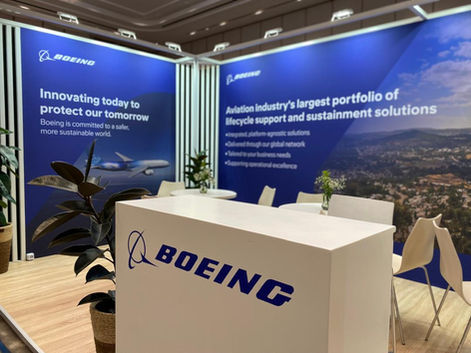
What Modular Exhibition Stands Look Like at Real Trade Shows in Africa
One of the barriers to adopting modular systems is the perception that they look generic or temporary. This may have been true a decade ago, but modern modular exhibition design has moved far beyond basic pop-up frames and banner stands.
Today's modular stands incorporate seamless fabric graphics stretched over aluminium frames, creating smooth, wrinkle-free brand surfaces that look identical to custom-printed hard panels. Integrated LED lighting systems provide the same visual impact as bespoke lighting rigs. Modular shelving, display units, and counter systems offer product display options that match custom joinery in functionality if not in weight.
At construction events like Big 5, modular stands can accommodate heavy product samples on reinforced shelving and incorporate demonstration areas. At food and beverage trade shows like Gulfood or agrofood Ethiopia, they can include refrigerated display zones, tasting counters, and branded hospitality areas. At technology events like GITEX Kenya, they integrate large screens, interactive displays, and clean tech-forward aesthetics.
The design flexibility means that a modular stand does not have to look modular. Visitors see your brand, your products, and your space. They do not see the aluminium profiles behind the graphics.

How to Transition From Custom Builds to Modular Exhibition Systems
Moving from traditional custom builds to a modular system does not require an overnight switch. Many exhibitors transition gradually, starting with specific components and expanding the modular elements over time.
A practical first step is to invest in a modular framework for your core stand structure while continuing to use custom elements for specific features like product display units or meeting furniture. This gives you the reusability benefits of the framework while retaining the bespoke feel of custom components where they matter most.
Work with your stand builder to develop a modular specification that covers your most common stand sizes and configurations. If you typically exhibit at 9, 12, and 18 square metre stands, the modular system should be designed to work at all three sizes with minimal additional components. This forward planning ensures that every investment in the system delivers value across multiple scenarios.
Storage between events is a practical consideration. Your stand builder should offer secure storage for modular components between shows, so the system is ready to deploy whenever the next event comes around. In East Africa, a builder who stores your components in Nairobi and fabricates additional elements locally for events in Addis Ababa or Dar es Salaam gives you the best combination of cost efficiency and flexibility.
Comparing the Total Cost of Modular Versus Custom Exhibition Stands
To illustrate the cost difference clearly, consider a company exhibiting at three events per year in East Africa over a three-year period.
With traditional custom builds, you pay full design, fabrication, graphic production, installation, dismantling, and disposal costs nine times. Each build is a standalone project with no carry-over value.
With a modular system, you pay for the framework design and initial fabrication once. For each subsequent event, you pay for graphic updates, reconfiguration, installation, and dismantling. The structural investment amortises across all nine events rather than being consumed by one.
Even accounting for the higher initial investment in quality modular components, most exhibitors break even by the second or third event. From that point forward, every additional event delivers increasing returns on the original investment. For companies planning a long-term exhibition strategy in Africa, the cumulative savings are significant.

Reduce Your Exhibition Costs and Environmental Impact in Africa
Modular exhibition systems are the smartest way to exhibit across multiple trade shows in Africa without multiplying your budget or your waste. They deliver the visual quality of custom builds, the flexibility of a system that adapts to any venue, and the cost and sustainability benefits that come from reusing rather than rebuilding.
Exhibit Africa designs, builds, and manages modular exhibition stand systems for companies exhibiting across Kenya, Ethiopia, Rwanda, and beyond. From initial concept and modular specification to local fabrication, storage between events, and installation at every venue, we make multi-event exhibition strategies practical, affordable, and sustainable.
Ready to stop rebuilding from scratch and start exhibiting smarter? Contact Exhibit Africa and let us design a modular system that works across every event on your calendar.
Comments