

How to Design a Country Pavilion That Delivers Results at African Trade Shows
A country pavilion is not just a bigger exhibition stand. It is a national showcase that represents an entire country's industries, products, and economic ambitions under one roof. Getting the design right means balancing national branding with individual exhibitor visibility, managing visitor flow across a complex multi-company space, and creating an environment that generates real commercial outcomes for every participant.

Country Pavilion Design Requires a Different Approach Than Standard Exhibition Stands
A standard exhibition stand serves one company with one message. A country pavilion serves five, ten, or fifty companies under a shared national identity. This changes every design decision.
The pavilion must project a unified national brand while giving each exhibitor enough space, signage, and visual identity to present their own products effectively. It must handle high volumes of visitors moving through a large, multi-zone space without creating congestion or dead areas. It must accommodate different exhibitor needs, from companies displaying small products on shelves to those demonstrating heavy machinery. And it must do all of this within a structure that can be fabricated locally and adapted to different venues across the region.
The complexity is real, but well-designed country pavilions consistently outperform individual stands in visitor engagement, media coverage, and commercial outcomes. The collective impact of a national presence is greater than the sum of individual booths.

Establishing a Strong National Identity Through Pavilion Architecture
The first job of a country pavilion is to be instantly recognisable as a national showcase. Visitors walking the aisles of a busy trade show in Nairobi, Addis Ababa, or Dubai should be able to identify the pavilion as a country exhibit from across the hall.
National identity in pavilion design is communicated through a combination of architectural form, colour, materials, and messaging. The most effective pavilions use the country's flag colours as a foundation for the colour palette without turning the space into a literal flag. Incorporate national colours into the structural elements, header graphics, flooring accents, and lighting rather than covering every surface in flag motifs.
An entrance arch or gateway structure is a proven technique for signalling a country pavilion. A tall, branded entrance with the country name, national emblem, and a tagline creates a clear threshold between the general exhibition floor and the national space. This architectural cue tells visitors they are entering a curated experience, not just passing another row of stands.
Use materials that reference the country's character where appropriate. Natural timber for Nordic pavilions. Stone or tile accents for Mediterranean nations. Sustainable materials like bamboo or recycled composites for countries positioning themselves as environmental leaders. The material choices should feel intentional, not decorative.

Balancing National Branding With Individual Exhibitor Visibility Inside the Pavilion
This is the central design tension in every country pavilion, and getting the balance wrong undermines the entire investment.
Too much national branding at the expense of individual exhibitors makes companies feel invisible. Their logos shrink, their products get lost, and visitors cannot distinguish one company from another. Exhibitors who feel they are paying to promote their government rather than their business will not return for the next event.
Too little national branding turns the pavilion into a collection of unrelated stands that happen to share a floor area. The collective impact is lost, and the pavilion looks disorganised from the aisle.
The solution is a clear visual hierarchy. National branding dominates the perimeter, the entrance structure, and the overhead elements. These are the elements visitors see from a distance and from outside the pavilion. Individual exhibitor branding lives within each company's allocated space, at eye level, where visitors engage with it during conversations. The national brand frames the experience. The exhibitor brand fills it.
Each exhibitor station should have consistent structural elements, such as uniform back walls, standard lighting, and matching furniture, with designated areas for their own logo, graphics, and product displays. This creates visual coherence across the pavilion while preserving each company's identity. Think of it as a well-designed shopping centre where the building architecture is consistent but each shop has its own personality.

Designing Pavilion Layouts That Manage Visitor Flow at Busy African Trade Shows
Visitor flow through a country pavilion is fundamentally different from flow through a single exhibition stand. A pavilion is a destination, and visitors expect to browse multiple exhibitors within the space. The layout must facilitate this browsing behaviour while preventing the congestion and dead zones that plague poorly designed pavilions.
The most effective layout pattern for country pavilions at high-traffic African exhibitions is a perimeter arrangement with a central open area. Individual exhibitor stations line the outer walls of the pavilion, each facing inward toward a shared central space. This creates a natural loop that visitors follow as they browse from one exhibitor to the next, with the open centre providing breathing room, circulation space, and a natural gathering point.
Avoid layouts that place exhibitor stations back-to-back in rows within the pavilion. This creates narrow corridors that feel cramped when busy and isolate exhibitors from each other. It also makes it difficult for visitors to see what is available without walking the full length of every row.
Position your strongest or most visually engaging exhibitors near the pavilion entrance to draw visitors in. Place exhibitors with live demonstrations or interactive displays at key turning points in the layout to maintain visitor momentum through the space. Leave the deepest positions for exhibitors who attract visitors through scheduled meetings rather than passing traffic.
Ensure every exhibitor station is accessible without visitors having to pass through another exhibitor's space. This sounds obvious but is regularly violated in pavilion layouts that prioritise maximising the number of stations over quality of access.
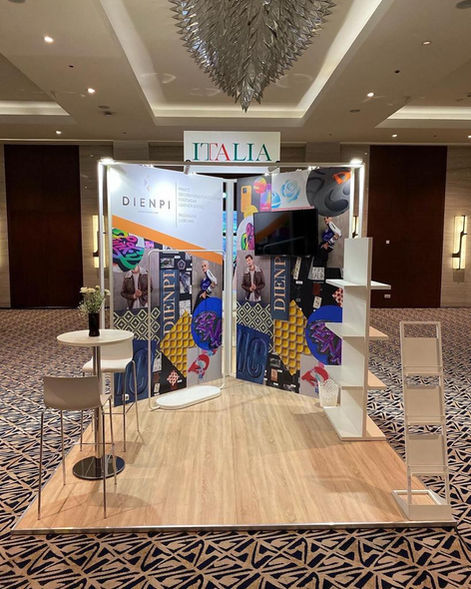
Creating Shared Spaces That Add Value to the Country Pavilion Experience
The best country pavilions include shared spaces that no individual exhibitor could justify alone but that elevate the entire pavilion experience.
A central meeting and hospitality area is essential. In African business culture, offering tea, coffee, or refreshments is a gesture of respect and a natural conversation starter. A pavilion hospitality zone where visitors can sit, have a drink, and be introduced to relevant exhibitors by a pavilion host adds a layer of engagement that individual stands rarely achieve. This area also serves as a venue for hosted buyer meetings, VIP receptions, and press briefings.
A presentation or stage area, even a small one, allows exhibitors to give short product presentations, and the pavilion organiser to host formal opening ceremonies, press conferences, or B2B matchmaking sessions. At events like Big 5 Construct Kenya and Propak East Africa, country pavilions with active programming draw significantly more foot traffic than those that simply offer static display space.
An information desk at the pavilion entrance, staffed by a dedicated host, serves as a first point of contact for visitors. The host greets visitors, identifies their interests, and directs them to the most relevant exhibitors. This concierge function dramatically improves the visitor experience and ensures that exhibitors receive pre-qualified introductions rather than random traffic.

Adapting Country Pavilion Design for Different Venues Across Africa
A country pavilion designed for the Sarit Expo Centre in Nairobi may not work at the AICC in Addis Ababa or the EIEC in Cairo. Venue specifications vary significantly, and pavilion design must account for these differences.
At the Sarit Expo Centre, where events like Intersolar Africa and Big 5 Construct Kenya take place, the halls are modern and well-proportioned with high ceilings and flexible power configurations. Pavilions here can utilise clean, contemporary design with elevated brand headers and integrated lighting.
At the Addis International Convention Centre, where Big 5 Construct Ethiopia and agrofood Ethiopia are held, the venue has different floor layouts, power specifications, and access routes. Pavilion design needs to account for these specific conditions, which is why working with a stand builder who has direct experience at the venue is critical.
At Dubai World Trade Centre and Expo City, where Gulfood takes place, the scale is dramatically larger. Pavilions at Gulfood compete with thousands of exhibitors across hundreds of thousands of square metres. Entrance structures need more height, signage needs more impact, and the layout needs to handle much higher visitor volumes.
The practical solution is to develop a pavilion design concept that is venue-adaptive. The national branding system, the colour palette, the exhibitor station specifications, and the shared space programming remain consistent. The structural layout, dimensions, and venue-specific engineering adapt to each location. A local stand builder who fabricates at each venue translates the concept into reality without shipping structures between countries.

Lighting and Graphics That Make Country Pavilions Stand Out on the Exhibition Floor
In a busy exhibition hall, a country pavilion competes for attention with hundreds of other stands. Lighting and graphic design are the tools that ensure your pavilion is visible, inviting, and professional.
Use overhead lighting to define the pavilion's footprint. A continuous light strip or suspended light line around the perimeter of the pavilion creates a visual boundary that distinguishes your space from the surrounding stands. This is particularly effective at large venues where the hall lighting is flat and uniform.
Backlit graphics on the entrance structure and perimeter walls create warmth and visual depth that standard printed panels cannot match. Backlit headers with the country name and emblem are visible from far across the hall, acting as wayfinding beacons that draw visitors toward the pavilion.
Within individual exhibitor stations, provide consistent task lighting that highlights products and creates a professional display environment. Adjustable spotlights allow each exhibitor to direct light onto their key products, while ambient lighting from the shared pavilion infrastructure provides the baseline illumination.
Graphic consistency across the pavilion is maintained through a shared design system. Define a template for exhibitor graphics that specifies font families, colour usage, logo placement, and image style. Distribute this template to exhibitors well in advance so their individual graphics align with the pavilion's overall visual language. The result is a space that feels curated and intentional rather than assembled from mismatched pieces.

Coordinating Multiple Exhibitors Through Clear Guidelines and Project Management
The most beautifully designed pavilion will fall apart without effective coordination of the exhibitors within it. Design and coordination are inseparable in pavilion projects.
Publish clear exhibitor guidelines at least three months before the event. These should specify the exact dimensions and layout of each exhibitor station, what is included in each station (furniture, lighting, power, signage), what exhibitors need to provide themselves (product samples, staff, promotional materials), branding guidelines including logo placement and graphic templates, setup and dismantling schedules, and rules for stand modifications and extensions.
Assign a dedicated pavilion project manager who acts as the single point of contact for all exhibitors and the link between the pavilion organiser, the stand builder, and the venue. This person manages timelines, coordinates deliveries, resolves conflicts, and ensures that every exhibitor is set up correctly and on time.
Hold a briefing session with all exhibitors before the event, ideally both virtually during the planning phase and in person on setup day. Use this session to walk through the pavilion layout, explain the shared facilities, introduce the hospitality team, and align expectations on visitor engagement and lead sharing protocols.

Measuring Country Pavilion Performance and Demonstrating Return on Investment
Trade promotion agencies funding country pavilions need to demonstrate measurable returns to secure future budgets. Building a measurement framework into the pavilion design from the start ensures meaningful data is captured.
Design the pavilion with data capture in mind. Install a visitor counter at the entrance to track total footfall. Provide each exhibitor with a standardised lead capture form or digital tool so that lead data is consistent and aggregable across the pavilion. Schedule formal B2B matchmaking sessions within the pavilion and record the number of meetings held and outcomes reported.
Post-event reporting should connect pavilion participation to tangible commercial outcomes. Track leads generated per exhibitor, meetings held, contracts or memoranda of understanding signed, media coverage achieved, and exhibitor satisfaction scores. This data builds the case for recurring pavilion participation and helps the organising agency refine the design and programme for future events.

Design and Build Your Country Pavilion in Africa
A country pavilion that truly represents a nation and delivers commercial results for every exhibitor requires design expertise, local venue knowledge, and flawless coordination from concept through to dismantling.
Exhibit Africa specialises in designing, fabricating, and managing country pavilions for trade promotion agencies, government ministries, and industry associations at trade shows across Kenya, Ethiopia, Rwanda, and the Middle East. From initial concept and 3D visualisation to exhibitor coordination, local fabrication, venue logistics, and full on-site management, we deliver end-to-end pavilion solutions at the highest standard.
Planning a country pavilion for a trade show in Africa? Contact Exhibit Africa and let us design a national showcase that delivers results for every exhibitor.
Comments